

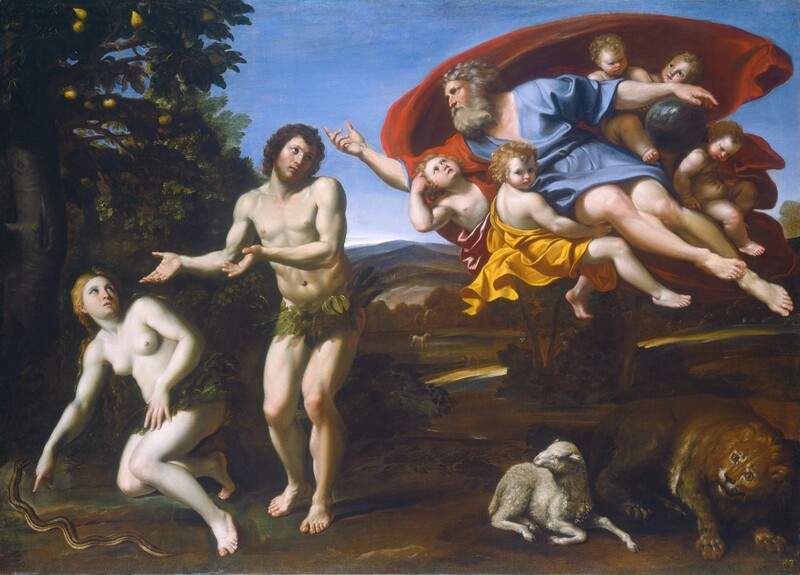
This article is lovingly dedicated to my son, Christian Gadiel, whose insightful conversations about the saints and the nature of sin were a profound inspiration for this work. He also contributed by selecting the powerful accompanying image, Domenichino's 'Adam and Eve,' for which I am deeply grateful.
To understand the chaos of the modern world—from the corruption in high offices to the silent breaking of vows in our homes—we must go back to the beginning. We must understand the nature of God, the nature of Love, and the terrifying necessity of the choice placed before Adam and Eve.
The story of the Garden of Eden is often reduced to a fable about a piece of fruit. But theologically, it is the story of a relationship, a stranger, and a test that continues to play out in every human heart today.
The Nature of Love: Why the Tree Was Necessary
The First Epistle of John defines the Creator with three words: "God is love" (1 John 4:8). This is not merely a description of what God does, but a definition of who He is. Before the foundations of the world, the Father, the Son, and the Holy Spirit existed in a perfect, inseparable communion of infinite love. God did not create humanity out of loneliness or need; the Trinity was already complete. Creation was an act of pure, overflowing generosity. He wanted to share that existence with us.
However, love possesses a fundamental law: Love cannot be coerced.
If God were to program humanity to love Him—like a computer code or a robot—it would not be love. It would be a simulation. Forcing someone to reciprocate affection is a form of spiritual violence; it is the nature of a tyrant, not a Father. As St. Paul reminds us, "If we are faithless, He remains faithful—for He cannot deny Himself" (2 Timothy 2:13). God, who is Truth, cannot act against His own nature. He cannot create a "lie" by giving us the illusion of free will while secretly forcing our hand.
This is why the Tree of the Knowledge of Good and Evil existed. It was not a trap set by a cruel deity. It was the necessary mechanism for human dignity. It was the question posed to humanity: “Do you trust Me? Do you love Me enough to let Me define what is good for you, or will you grasp at autonomy and decide for yourself?”
The Catechism of the Catholic Church teaches that the prohibition of the fruit symbolizes that "man's ability to decide what is good and what is bad" belongs to God alone (CCC 396). The "test" is simply this: Will man trust the Creator, or will he try to become his own god?
The Serpent as the Stranger
The tragedy of Eden was not merely eating a piece of fruit; it was a profound betrayal of a relationship. Consider the context: God had given Adam and Eve everything. He crafted them with perfect bodies, placed them in a pristine world, and gave them dominion over all creation. He proved His goodness through every leaf, river, and sunset in Paradise. Crucially, He demonstrated His love for Adam by creating Eve—God saw that Adam needed a companion to share life with, and He provided the perfect helper.
God held nothing back. His track record with humanity was 100% goodness, blessing, and provision.
Then came the Serpent.
The theological horror of the Fall lies in who the Serpent was compared to who God was. The Serpent was a stranger. The Serpent did not form Adam from the dust. The Serpent did not fashion Eve from the rib. The Serpent had invested nothing in their well-being, had provided no food, no shelter, and no life.
Yet, Adam and Eve took the word of this stranger over the Word of God, who had sustained them.
In that moment, the Serpent feigned love. He pretended to care more about Adam and Eve's potential than God did. "God knows that when you eat of it your eyes will be opened, and you will be like God" (Genesis 3:5). The Serpent framed God as a restrictor of joy, and presented himself as the liberator. Adam and Eve believed that this stranger—who had done nothing for them—loved them more than the Father who had given them everything.
The Anatomy of Sin: Trusting the Stranger
Every sin committed today follows this exact pattern. Whether it is adultery, fraud, corruption, or pride, the mechanism is a replay of Eden.
- Adultery: In marriage, God provides a spouse—a "helper" just as He did for Adam. He blesses the union with a sacrament. But then, the "Serpent" arrives in the form of a third party. This person is a stranger to the covenant. They were not present when the marriage vows were made; they did not build the home, endure the lean years, or hold the family together. Yet, the adulterous spouse trusts this stranger’s promise of "happiness" over the God who ordained their marriage. They believe the lie that the stranger loves them more than the spouse God provided.
- Corruption and Greed: God promises to provide our daily bread. He gives us dignity in work. But the Serpent appears in the form of a bribe, a kickback, or a fraudulent scheme. The temptation whispers, "God is holding out on you. You could have more, faster, if you just ignore the rules." The corrupt individual trusts the "stranger" of easy money over the Providence of God, only to find—like Adam and Eve—that they are left naked and ashamed.
- Pride and Relativism: Pope Benedict XVI warned of the "Dictatorship of Relativism," which is precisely what the Serpent offered: the idea that we can decide what is good and evil based on our feelings. When we reject Church teaching or the Natural Law because "we know better," we are repeating the original sin. We are trusting our own limited intellect (the stranger) over the Eternal Wisdom of God.
Integrity is the Echo of Truth
Why is sin—any sin—an insult to God? Because it is a declaration of mistrust. When we sin, we are telling God: "I do not trust that You want what is best for me. I believe this Serpent (this affair, this bribe, this lie) has my best interests at heart more than You do." It is the ultimate ingratitude.
Integrity, then, is the reversal of the Fall.
Integrity is not just "following rules." Integrity is the spiritual discipline of looking at the Serpent—whether it manifests as a seductive person, an illegal contract, or a moment of pride—and saying: "No. I know who my Father is. I look at His track record, and I see only love. I look at you, and I see a stranger."
St. Augustine defined sin as curvatus in se—humanity curving inward on itself. Instead of looking to God (the source of light), we look to created things for satisfaction. Augustine argues that when we sin, we seek a "good" something in the wrong way. We want the fruit (pleasure, money, power), but we steal it rather than receiving what God wants to give us in His time.
St. Thomas Aquinas teaches, "To act against conscience is always a sin." Our conscience is the echo of God's voice in the garden. Life is a test to see if we will listen to that voice.
The Tree is still in the middle of the garden of our lives. Every day, we are presented with the choice. Will we trust the Stranger who promises us godhood but delivers death? Or will we trust the Father who has already given us everything, including His own Son, to restore what we broke?
To choose integrity is to choose God. It is the only choice that leads to life.
Comments
Post a Comment